Microwaves and Microwave Drawers
Built-in Dacor microwaves and microwave drawers in the Bay Area: the four models we list, label locations, common complaints and safe owner…

Specialized Dacor Appliance Repair in San Francisco
Mon–Sat: 8:00 AM – 7:00 PM
Cold food, a door that will not latch or a drawer that sticks: we trace it in the cabinet where the microwave actually lives.
Dacor repairSan Francisco & the Bay Area
A Dacor microwave rarely sits on a counter. In most Bay Area kitchens it is built into a tall cabinet run, tucked under a wall oven, or set into an island as a drawer, with trim kits and panel work that leave very little room around it. That changes how problems show up and how we chase them. A unit that runs hot in the cavity but never warms the food, a turntable that stalls, a door that will not latch, or a display that goes dark after a power blip all start with the same step: a technician looks at the installation as well as the appliance.
The light comes on, the fan hums, the timer counts down, and the plate comes out as cold as it went in. Inside a microwave this points toward the high-voltage side of the cooking system, which is sealed away from the owner for good reason. A technician tests the parts in that chain in a safe order rather than swapping the most expensive one first. Our article on Dacor microwave not heating walks through what that situation usually means from the kitchen side.
A microwave will not cook unless several door switches agree that the door is shut. Food splatter along the latch hooks, a slightly bent hook, or a cabinet trim kit that presses on the door can all interrupt a cycle. The unit may start, run for a few seconds and shut off, or refuse to start at all.
A grinding turntable, a buzz from the cavity, or a flash inside the oven can come from a worn drive coupling, a food-damaged cavity lining, or a damaged waveguide cover. Any visible arcing or burning smell is a reason to stop using the oven, which we cover in a separate section below.
Dacor microwaves are specified alongside wall ovens and coffee systems so the whole wall reads as one run. Trim kits, filler panels and the cabinet cutout set how much air can move around the cabinet shell. A microwave that is boxed in too tightly, or whose vent opening has been covered by a shelf liner or a storage basket, can shut itself down from heat and then work normally after it cools. Technicians look at clearances and airflow before blaming electronics.
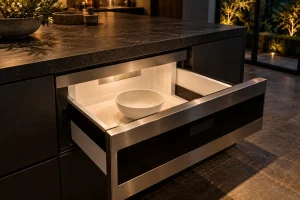
Microwave drawers raise a different set of questions. The drawer glides on a rail system and opens on a motorized or push-assisted mechanism, and the cabinetry around it is often panel-ready. A drawer that stops short, drags to one side or will not stay shut may have a bent rail, a crumb-jammed track, or a front panel that has shifted. We check the panel alignment and the opening path before we look at the cooking electronics.
You receive a written estimate after the diagnosis. Nothing is repaired until you approve it.
These are all done from the outside and none require tools.
Do not remove the outer cover, do not test inside the cabinet with a meter, and do not bridge a door switch to make the oven start. The inside of a microwave holds stored energy that can hurt you even after it has been unplugged.
Stop right away if you see sparks or a bright flash in the cavity, smell burning, notice a melted or scorched spot on the door seal, or find that the door is visibly bent or no longer closes flat. Switch the power off at the breaker and leave the unit alone. A microwave with a damaged door or seal should not be used again until a technician has checked it. Do not keep trying a unit that trips the breaker each time it runs.
Dacor has sold microwaves in several formats, and a drawer is built nothing like a door-opening unit. The model label tells us which of them is in your cabinet, and with that, which switch, board and mechanism set to expect. It is usually found on the oven frame, along the door opening, or behind the drawer front edge. Photograph it before the visit if you can reach it without moving the unit.
Models we see here include the DCM24S, a 24-inch microwave, and the DMO30U970SS, a 30-inch microwave. On the drawer side we work on the DMR24M977WM, a 24-inch microwave drawer, and the DMR30M977WM, a 30-inch microwave drawer. The full range is gathered on our Dacor microwaves guide.
We come to flats, condos, hillside houses and suburban homes across San Francisco and the Bay Area. Before the visit, have the model number, a short description of the fault, and a note on what you have already tried. If a drawer or door is damaged, a photo helps. Parking and building access notes for tight streets save time on arrival. If your kitchen also has an oven stack, our Dacor wall oven repair page covers the unit that often sits directly above or below the microwave.
If the unit only runs without warming, it is not dangerous by itself, but continuing to run it empty or hoping it recovers can stress other parts. Stop using it, do the outside checks above and book a diagnosis. If there are sparks or a burning smell, switch it off at the breaker straight away.
Often yes, for door, latch, turntable and control complaints. When a part inside the chassis has to be reached, the technician may need to slide the unit forward through its trim. We tell you before that happens and protect the cabinetry around it.
Crumbs in the track, a bent glide or a front panel that has moved can all do this. A technician checks the rail path and the alignment of the panel first, then the drive mechanism that moves the drawer.
Write it down exactly and note the model number. Do one controlled reset at the breaker. If the message returns, give both to the technician when you book, as they speed up the diagnosis.
That depends on the damage found and how the unit fits your cabinetry. Our article on repair or replace a Dacor appliance lists the factors. After diagnosis you get a written estimate and you decide.
Built-in Dacor microwaves and microwave drawers in the Bay Area: the four models we list, label locations, common complaints and safe owner…
Repair for Dacor gas, electric and induction cooktops and rangetops across San Francisco and the Bay Area, with diagnosis first and your…
Dacor dishwasher repair in San Francisco and the Bay Area for leaks, standing water, fill problems, heater faults and display codes in…
Repair for Dacor column freezers in San Francisco and the Bay Area: thawing food, heavy frost, drain ice and constant running, diagnosed…
Dacor ice maker repair in San Francisco and the Bay Area, covering empty bins, fused cubes, slow harvests and leaks from the…
Share a few details and we’ll confirm an appointment. Prefer to talk? Call us and we’ll help right away.