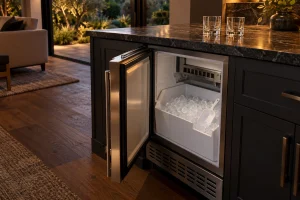
Ice Makers in San Francisco
Ice makers in Dacor kitchens, from slow production and hollow cubes to water leaks at the bin. What a technician checks and…

Specialized Dacor Appliance Repair in San Francisco
Mon–Sat: 8:00 AM – 7:00 PM
Empty bin, fused cubes or water on the floor: we trace the problem along the water line, the freezing cycle and the controls.
Dacor repairSan Francisco & the Bay Area
An ice maker is one of the few appliances that connects to water, power and cold air all at once, so a fault can start in any of three places. You may find an empty bin, a block of ice fused together, a tray that never fills, or water around the base. We repair Dacor ice makers in San Francisco and throughout the Bay Area, whether they are built into a refrigerator column or installed as a stand-alone unit.
The ice maker needs water, cold enough air and a working harvest cycle. If the supply valve is closed, a filter is clogged or the line is kinked, nothing arrives. If water arrives but the air is not cold enough, the cubes never form. If both are right, the harvest mechanism or the control that tells it to cycle may have failed. The technician follows that sequence in order, and our guide on a Dacor ice maker not working outlines it for owners.
Thin, odd-looking cubes usually mean the water fill is restricted or the filter is tired. They are an early warning, since a fully blocked supply is a short step away.
Clumped ice points to cubes that thawed slightly and refroze, often from infrequent use, warm air reaching the bin or a door that does not seal. It can also come from a drain that lets meltwater sit in the bin.
Leaks come from the supply connection, the fill tube, a cracked reservoir or a drain that has frozen and then overflowed. The wet spot is rarely where the leak begins, so the technician traces the path of the water from its source.
Grinding while the ice drops or a motor that hums without moving suggests the harvest or drive mechanism is struggling. A bin that stays jammed on a stray cube produces similar sounds, and clearing it is the first step.
We look at the water path first, from the supply valve through the filter and the fill line, because it is the cheapest to confirm and the most common cause. Then we check temperatures, the harvest cycle and the controls. The written estimate names the fault and the repair, and nothing is replaced until you approve it.
Most ice makers depend on a dedicated water line behind or beside the cabinet. Built-in installations push the unit tightly into an opening, and that can pinch a line that was fine before. Stand-alone and under-counter units also need a drain, and a drain that runs uphill, sags into a trap, or loses its air gap holds water in the bin and encourages fused, cloudy ice. A pump-assisted drain adds another component that can clog with scale.
Water quality plays a role as well. In many Bay Area homes the supply carries enough mineral content to coat the fill valve and the freezing surface over time, and a filter that has been left in place too long slows the flow. The outcome is slow, small ice before the machine stops altogether. In older San Francisco buildings the shutoff valve under a sink may not have been touched in years and can be partly closed without anyone noticing. A kitchen where the ice maker sits near the oven or a sunlit window works against its own cooling.
Do not pry ice off the evaporator with a tool, tighten fittings at the back of the unit, or run water into the machine to speed things up. If the ice maker is built into a refrigerator, keep your hands out of any moving mechanism.
Turn off the water supply and unplug the ice maker if you see water running onto the floor. Switch the power off at the breaker if you smell burning or see sparks. Ice that tastes or smells unpleasant should be thrown out and the bin cleaned before anyone drinks from it, and if the smell remains, request a visit instead of scrubbing repeatedly.
Dacor ice makers are not one design: an ice maker built into a refrigerator works differently from a freestanding unit, and the water connection, the drain and the control are all different. The model number is usually on a label inside the cabinet or along the door frame, and this guide helps you find it. Many Dacor refrigerators with ice and water, such as the DYF42BSIWS side-by-side, share the same water-line concerns described here.
You describe what you see and tell us the model number. At the appointment the technician checks the water path, the freezing cycle and the controls, explains what was found, and writes up an estimate. Work begins only when you approve it. We take requests Monday to Saturday, 8:00 AM to 7:00 PM, for San Francisco and the surrounding Bay Area.
See the Dacor ice makers guide for the lineup, and Dacor refrigerator repair if the ice maker is part of a refrigerator that is also running warm. For a broader view of problems by symptom, visit common Dacor problems.
Small or hollow cubes usually mean the water supply is restricted, often by a tired filter or a partly closed valve. It is an early warning before the ice stops completely.
Look at the ice maker switch, the bin position, the water supply valve and the filter. If all are fine, the harvest cycle or the control needs a technician.
Cubes that melt slightly and refreeze fuse together. Infrequent use, a door that does not seal or standing meltwater in the bin are the usual reasons.
Not always, but it should be traced. Water may come from the supply line, the fill tube, a cracked part or a frozen drain that overflowed.
Many do, and a drain with poor slope or no air gap can hold water in the bin. The installation is checked as part of the diagnosis.
Ice makers in Dacor kitchens, from slow production and hollow cubes to water leaks at the bin. What a technician checks and…
Repair for Dacor gas, electric and induction cooktops and rangetops across San Francisco and the Bay Area, with diagnosis first and your…
Dacor dishwasher repair in San Francisco and the Bay Area for leaks, standing water, fill problems, heater faults and display codes in…
Repair for Dacor column freezers in San Francisco and the Bay Area: thawing food, heavy frost, drain ice and constant running, diagnosed…
Built-in Dacor microwaves and microwave drawers in San Francisco and the Bay Area: heating, door, turntable and drawer faults diagnosed and repaired.
Share a few details and we’ll confirm an appointment. Prefer to talk? Call us and we’ll help right away.