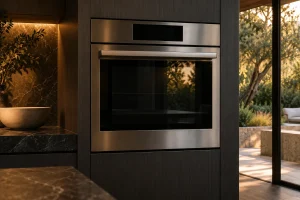
Wall Ovens
Single and double Dacor wall ovens in San Francisco and the Bay Area: models we list, where the label sits, display codes…

Specialized Dacor Appliance Repair in San Francisco
Mon–Sat: 8:00 AM – 7:00 PM
Built-in ovens need careful handling. We diagnose the fault, explain it and wait for your approval before repairing.
Dacor repairSan Francisco & the Bay Area
A wall oven sits at eye level, runs for hours on holidays, and is built into cabinetry that was cut to fit it exactly. When a Dacor wall oven stops behaving, the question is rarely just what broke; it is also how to get at it without disturbing the cabinet around it. We repair Dacor single, double and combination wall ovens across San Francisco and the Bay Area.
When the display is lit but the cavity stays cool, a technician looks at the bake and broil elements, the relay that powers them, and the sensor that tells the control what the cavity is doing. A related article, Dacor oven not heating, sets out the order of checks.
Food that browns too fast, or a cake that never sets, may point to a drifting sensor, a damaged door seal or an element that heats only partly. See Dacor oven temperature problems for the symptoms in detail.
After self-clean, the latch motor, its switches and the control must all agree before the door releases. If one signal is missing, the door stays shut. The article on a Dacor oven door that will not unlock explains what is happening inside the latch.
The cooling fan protects the control and the cabinet around the oven. If it runs long after the oven is off, the control may still sense heat or a sensor may be misreporting; see Dacor oven cooling fan keeps running.
Touch and membrane panels age. A key that sticks, a display that dims or a clock that resets after every power flicker can mean a worn panel or a failing board.
Dacor wall ovens report faults in several styles depending on the generation. The Dacor documentation we use describes these groups:
The article Dacor oven error codes collects the families side by side. Always write the code exactly as displayed, including dashes and letters.
Wall ovens are installed in a cutout, and the cutout is the challenge. A single oven under a counter, a double oven in a tall cabinet, and a unit stacked with a microwave or warming drawer each present a different set of limits. To reach the rear of the oven, we often have to slide the unit forward on its cabinet floor, which means clearing trim and, in tight remodels, checking that the surrounding panels will not be marked.
Electrical supply is hardwired in most built-in installations. A double oven has two separate cavities and two sets of controls, so a fault in the upper does not necessarily mean the lower is affected, and the comparison helps in diagnosis. Panel-ready fronts and flush surrounds look seamless but leave little room for a door to open fully when it is serviced.
Many San Francisco kitchens are on the upper floors of buildings with narrow stairs and elevators, so the way a heavy oven is moved matters before any repair begins. We plan the approach so the unit is secured and the floor is protected.
Many wall oven faults surface right after a self-clean cycle or a long holiday bake. The cycle pushes the cavity hard, runs the latch through its full sequence and loads the cooling fan, so a part that was marginal tends to fail then. If your oven stopped working during or just after a clean, tell us at booking, because it narrows the search to the lock, the sensor and the fan. Clearing racks, foil and spilled food before a clean cycle also keeps smoke and residue away from the elements and the sensor.
Double ovens add another layer. When both cavities share a control, a fault that appears in one may be a board issue rather than a heating issue, and testing the second cavity gives us a quick comparison before we open anything.
If you smell burning or see sparks, turn the oven off at the breaker. If the door is stuck after a clean cycle, let the oven cool and do not force the handle.
Stop using the oven if it shows a high-temperature alarm, if it heats without responding to the controls, or if a lock fault traps the door during a cycle. Forcing a latch that has lost a signal can bend the lock assembly and turn a modest repair into a larger one.
Dacor wall ovens span several generations, and their latches, sensors and boards vary. The label is usually on the oven frame, near the door opening. Our guide to finding your Dacor model number shows where to look in a built-in unit.
We start with diagnosis and tell you what we found. A written estimate follows, and nothing is repaired without your approval.
Browse the Dacor wall oven guide for the range of units. Pages for the ECD227, DOB30P977DS double wall oven and ECS127 cover typical issues for each.
The control can be powered while an element, a relay or a sensor has failed. A technician tests each in turn.
For a while, yes, as the cavity cools. If it never stops, we look at the sensor and control.
Let the oven cool fully and try again. Do not force it.
No. One visit covers both, and the comparison between them often speeds up the diagnosis.
Write it down anyway and request a visit. We will check it against the Dacor documentation for your unit.
Single and double Dacor wall ovens in San Francisco and the Bay Area: models we list, where the label sits, display codes…
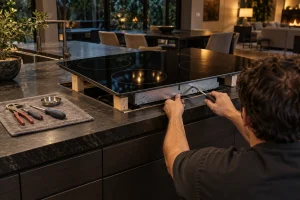
Repair for Dacor gas, electric and induction cooktops and rangetops across San Francisco and the Bay Area, with diagnosis first and your…
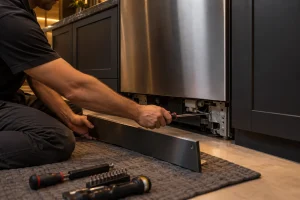
Dacor dishwasher repair in San Francisco and the Bay Area for leaks, standing water, fill problems, heater faults and display codes in…
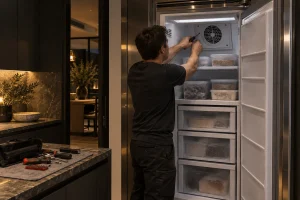
Repair for Dacor column freezers in San Francisco and the Bay Area: thawing food, heavy frost, drain ice and constant running, diagnosed…
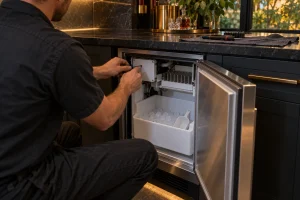
Dacor ice maker repair in San Francisco and the Bay Area, covering empty bins, fused cubes, slow harvests and leaks from the…
Share a few details and we’ll confirm an appointment. Prefer to talk? Call us and we’ll help right away.