

Specialized Dacor Appliance Repair in San Francisco
Mon–Sat: 8:00 AM – 7:00 PM
The label is almost never where you first look. This guide lists the usual spots for refrigerators, ovens, cooktops, hoods and drawers, and what to do if you cannot reach it.
Dacor repairSan Francisco & the Bay Area
When you call about a repair, the first thing we ask for is the model number, and the second thing is usually silence while someone hunts for it. Dacor labels sit in different places depending on the appliance, and in a built-in kitchen the label can be hidden by cabinetry. A few minutes with a flashlight and a phone camera save a lot of back and forth.
The data label is a small plate or sticker that carries the model number, a serial number and the electrical data. Write down the model number exactly, letter for letter, including any dashes. Photograph the whole label too, because a photo avoids transcription mistakes between a letter O and a zero, or a one and a capital I.
Dacor model numbers vary widely in length and format, from short ones for older units to longer alphanumeric strings. Do not try to decode the letters yourself or guess at a series from the prefix. Give us the full number and we will tell you what it means.
Open the fresh-food door and look along the inside wall or the top inside edge, and also on the frame around the door opening. On column units, check the inside side wall near the top or the frame by the hinge. Some units place it under the crisper drawers or on the ceiling of the compartment, so look inside before pulling anything out.
The label is usually inside the cabinet, on the side wall near the top or on the frame behind a shelf. For a built-in unit, you may need to take out a rack to see it.
Look on the inside wall of the cabinet, near the opening, or on the frame under the door. If the unit is under a counter, open the door fully and shine a light along the top and sides.
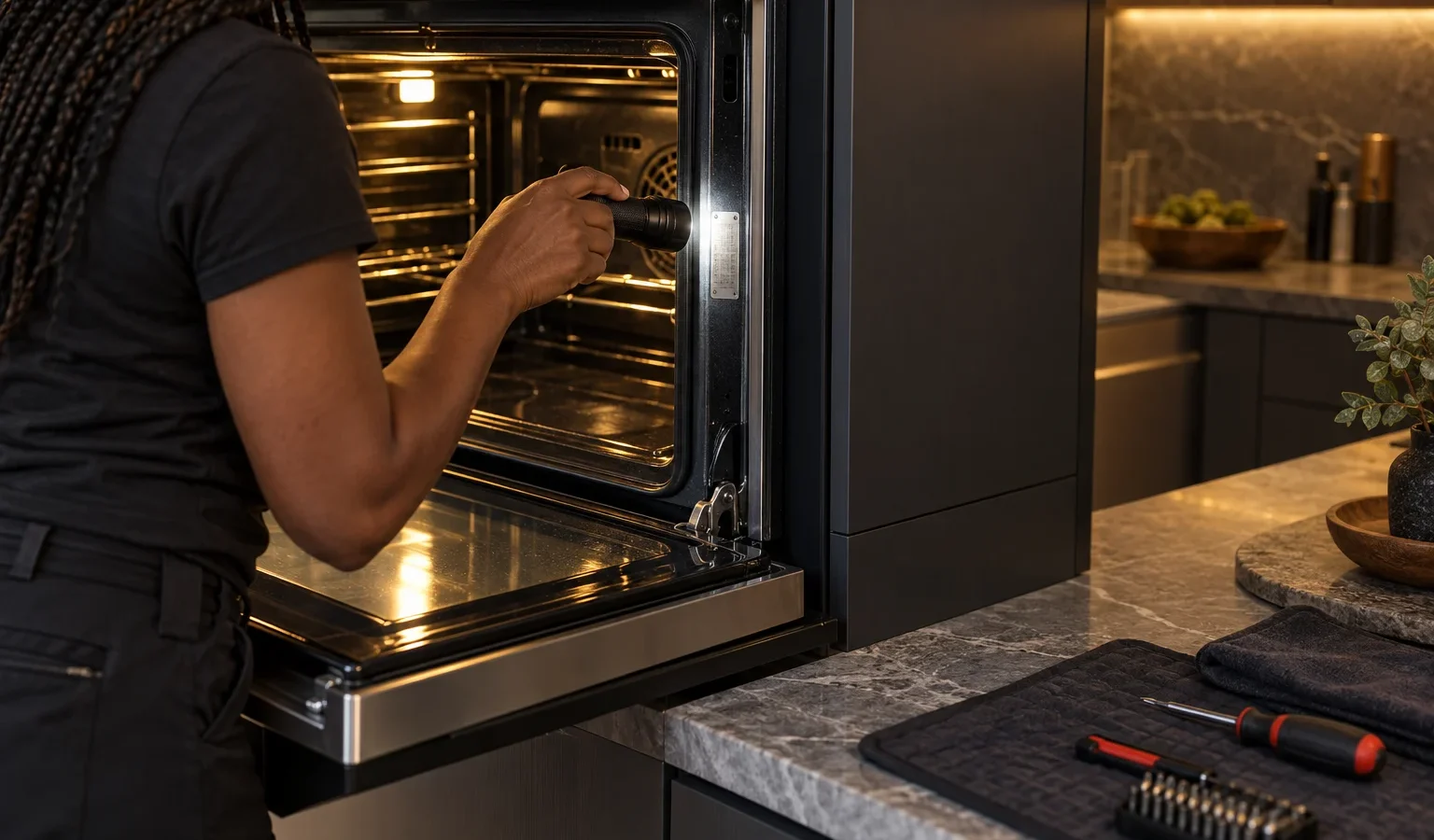
Open the oven door and look on the oven frame, usually along the side or the top edge of the opening. On double ovens, check both the upper and lower frame. The label is on the frame, not inside the cavity.
Open the oven door, then look on the frame, or open the storage or broiler drawer and check the edge of the opening. Slide-in and professional-style ranges often have it behind the drawer front.
The label is usually on the side or underside of the cooktop chassis, and on a built-in that means it is below the counter. If you can open a cabinet door below the cooktop, look there with a flashlight. Do not unscrew anything to find it.
Open the door or pull the drawer fully out and check the frame. On a drawer unit, the label is often along the front edge or inside the opening.
Pull the drawer fully out and look on the drawer front edge or on the frame behind it. A drawer finished with a panel-ready front may hide the label until the drawer is out.
Remove the grease filters, which usually pop out by hand, and look on the inside of the hood body behind them. For island and wall hoods, a flashlight helps. Downdraft units may have a label on the side of the housing that is visible when the vent is raised.
Open the door and check the edge of the tub or the inside of the door panel, which usually carries the label along the side or top. Panel-ready models may have it behind the front panel.
Never pull a built-in unit out of its opening to look for a label. Many are heavy, gas or water lines may be attached, and you could cause more trouble than the label is worth.
The model number tells us which control board, heating parts or fans the unit uses, and it also lets us check the error code list that applies. It separates a Modernist induction cooktop from a classic gas rangetop, a combi oven from a standard oven, and an older Epicure refrigerator from a newer one. Parts and wiring are not interchangeable between them. Send it along when you book, and the first visit goes further.
With the number in hand, choose the right service page: Dacor refrigerator repair, Dacor wall oven repair, Dacor cooktop repair or Dacor range hood repair. If the number is on a code-bearing display, our Dacor error codes explained guide shows how to read the code that goes with it.
When you book, we diagnose first, explain what we found and give you a written estimate. Nothing is repaired without your approval.
The model number identifies the type of appliance and the serial number identifies your individual unit. We usually need the model number first.
Almost always. Check inside the door frame, along the oven frame, behind the filters or at the drawer front edge, and use a flashlight and a phone camera.
No. Anything shown on the display during a fault is usually an error code, not a model number. Write down both separately.
Photograph whatever is readable and send it with a description of the appliance. Original paperwork or a remodel specification sheet may also carry the number.
It is not required to book, but it makes the first visit more useful because we can prepare for the right unit.
Share a few details and we’ll confirm an appointment. Prefer to talk? Call us and we’ll help right away.