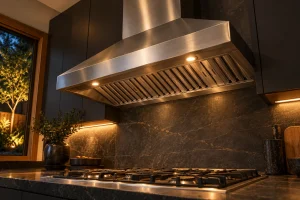
Range Hoods and Ventilation
Dacor hoods, downdraft vents and integrated ventilation in Bay Area kitchens: the models we list, label locations, common complaints and safe filter…

Specialized Dacor Appliance Repair in San Francisco
Mon–Sat: 8:00 AM – 7:00 PM
A fan that will not start, a rattle, or smoke that lingers: we follow the air from the cooktop to the outside wall.
Dacor repairSan Francisco & the Bay Area
A Dacor hood is judged by what you cannot see: the air it moves while you sear a steak, and the quiet when it is idle. When the fan weakens, rattles or does not start at all, the effect shows up fast as grease on the cabinets, steam on the windows and a kitchen that smells of last night. We repair wall hoods, island hoods, downdraft vents and integrated ventilation systems for kitchens in San Francisco and the Bay Area.
You press the button and nothing happens, or the light works while the blower stays still. A technician separates the possibilities: no power reaching the unit, a control or switch that no longer sends the signal, a motor that has failed, or a protective cutout that tripped from heat. Our article on a Dacor range hood fan not working covers that sequence from the owner side.
A squeal usually points to a bearing, a rhythmic thump to a blower wheel that is out of balance or carrying a layer of grease, and a metallic buzz to a loose panel or a duct joint. Noise that changes with the fan speed is a different clue from noise that is constant. We explain the common patterns in Dacor range hood making noise.
A hood that runs but fails to clear the air is often a ducting problem, not a motor problem. A crushed elbow, a closed damper flap, a clogged filter or a wall cap that no longer opens can all choke the flow.
Lamps that flicker or go dark, speed selections that do not respond, and touch controls that behave on their own come from the lamp sockets, the control board or the harness, which a technician checks separately from the fan.
Hoods differ more by how they are installed than by almost any other appliance. A wall-mounted hood has a straight or angled duct run to an exterior wall or roof, and the longer or more twisted that run is, the harder the blower has to work. An island hood hangs from the ceiling and must push its exhaust a long way, often through a chase that was built during a remodel. Many San Francisco flats and condos have limited routes to the outside, so ducts sometimes make more turns than anyone would like.
A downdraft vent pulls air downward behind or beside the cooktop and sends it through ductwork under the floor or cabinet. It is exposed to grease and spills at the very point where it takes air in, so cleaning and moisture become real factors. An integrated ventilation system hides the blower in the cabinetry, which means the cabinet itself becomes part of the airflow path, and alignment matters.
The cooktop below matters too. A powerful gas or dual-fuel top calls for good airflow, and a hood that was sized for an earlier appliance may struggle after a kitchen upgrade. We note what is underneath before assuming the hood is at fault.
Do not remove the canopy, do not reach into the blower housing, and do not try to clean the duct with the fan switched on. Wiring, a spinning wheel and grease deposits all make that unsafe.
Turn the power off at the breaker if you smell burning, see smoke from the motor area, hear a scraping sound that gets louder, or see sparks from the lamp sockets. A hood with a failing motor can overheat, and grease deposits near a gas flame are a hazard in their own right. If you ever smell gas, leave the home, avoid switches and call the gas utility or 911 from outside.
Blowers, filters and downdraft hardware differ between lines. The label tells us which family of parts applies. On a hood it is usually behind the filters, and on a downdraft vent it may sit on the housing beneath the cooktop.
The models we see most include two Epicure hoods, the EH30 and the EH36, the HRV46S, a Heritage downdraft hood in a 46-inch size, the MRV3015ERS, a downdraft vent, and the RNIVS1, an integrated ventilation system. The wider lineup is on the Dacor range hoods guide.
When you contact us, tell us the model number if you can read it, the type of mount, and what the hood does. If your ventilation sits over a rangetop, our Dacor cooktop repair service pairs well with it, since the two work as a system. We serve San Francisco and the wider Bay Area.
A blocked filter, a closed damper or a restricted duct is more likely than a failed motor. A technician checks airflow along the whole route to the outdoors.
That depends on how much you cook and with how much oil. When they look greasy or the air pull feels weaker, it is time, and a dirty filter is a likely reason for noise as well.
In many cases yes, although the raising and lowering mechanism and the blower sit in tight cabinetry. We explain what has to be reached before any work begins.
Not always, but a new squeal or grinding is a sign that something is wearing or loose. If it comes with heat or a burning smell, switch it off at the breaker.
We inspect the duct as far as it can be reached and tell you what we find. Any repair is described in your written estimate and goes ahead only with your approval.
Dacor hoods, downdraft vents and integrated ventilation in Bay Area kitchens: the models we list, label locations, common complaints and safe filter…
Repair for Dacor gas, electric and induction cooktops and rangetops across San Francisco and the Bay Area, with diagnosis first and your…
Dacor dishwasher repair in San Francisco and the Bay Area for leaks, standing water, fill problems, heater faults and display codes in…
Repair for Dacor column freezers in San Francisco and the Bay Area: thawing food, heavy frost, drain ice and constant running, diagnosed…
Dacor ice maker repair in San Francisco and the Bay Area, covering empty bins, fused cubes, slow harvests and leaks from the…
Share a few details and we’ll confirm an appointment. Prefer to talk? Call us and we’ll help right away.