

Specialized Dacor Appliance Repair in San Francisco
Mon–Sat: 8:00 AM – 7:00 PM
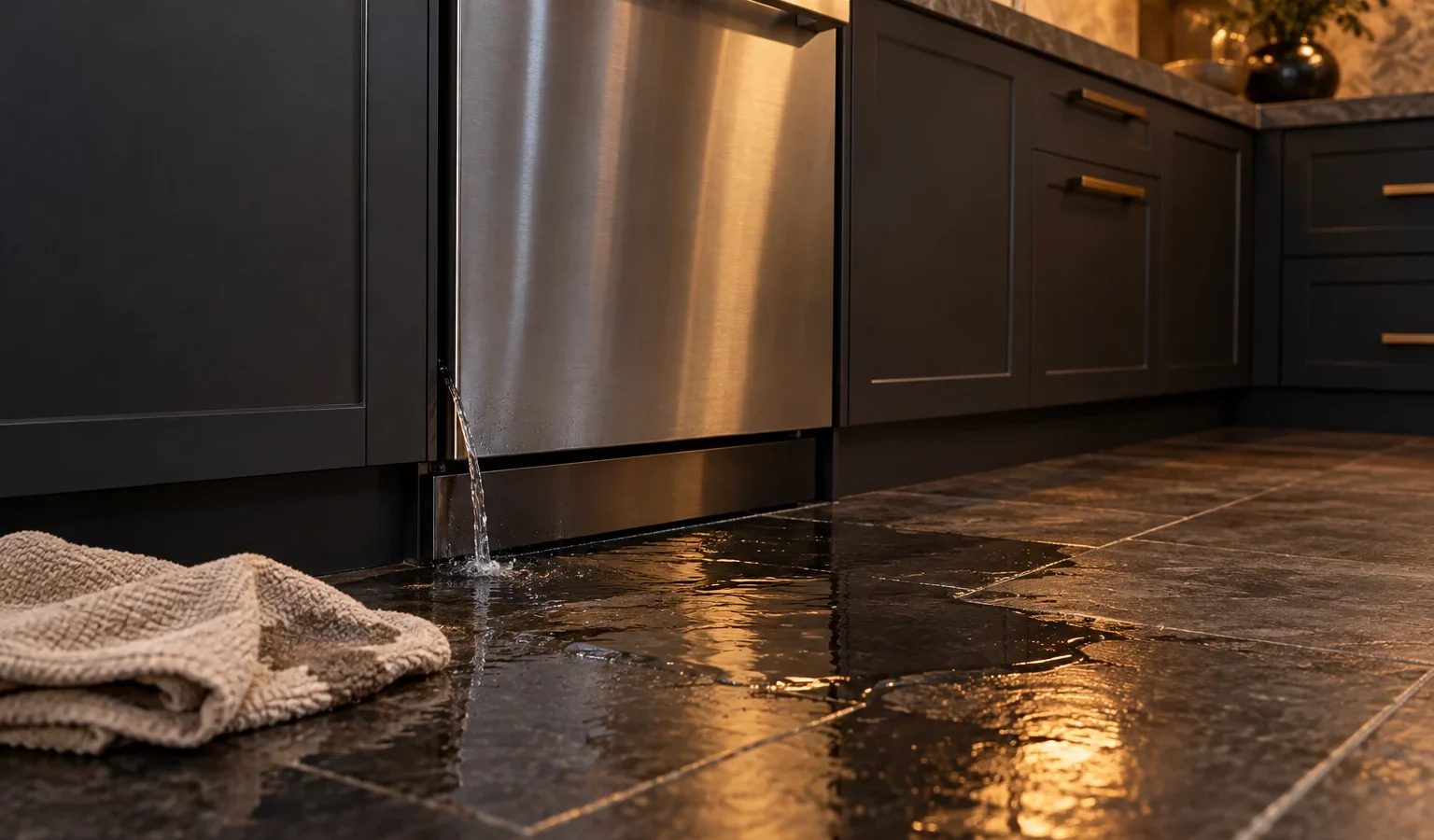
Water on the floor in front of a Dacor dishwasher can come from the door, the tub or the plumbing behind it. Work out which, and stop it before it reaches the cabinets.
Dacor repairSan Francisco & the Bay Area
A puddle in front of a built-in dishwasher rarely tells you where the water started. It may have run down the inside of the door, dripped from a hose connection under the sink, overflowed because the drain backed up, or escaped through a seal. Each source has a different fix, and some are not the dishwasher’s fault at all. The first job is to protect the floor and cabinets, and the second is to narrow the source from the outside.
Switch the dishwasher off at its breaker. Close the water supply valve, usually under the kitchen sink. Soak up standing water, especially along the toe-kick and under neighboring cabinets, where moisture can sit unseen against particleboard. If the leak happens while the dishwasher is running, cancel the cycle and let it stop before you open the door.
Water that appears at the sides or bottom of the door during a wash often points at the door seal. Food residue or a pinched section of gasket stops it from seating. A door that does not latch evenly, perhaps because a panel-ready front was added and changed how the door hangs, can also let spray past the seal.
Too much detergent, or the wrong kind, creates suds that push out around the door. That is a usage issue, but it can look like a hardware leak. If you recently changed detergent, that is useful information.
If the dishwasher cannot empty, water rises and finds the lowest exit. A clogged drain screen, a kinked hose or a blocked air gap or disposal connection can all produce a leak that is really a drain problem. Our guide to Dacor dishwasher not draining covers that side.
The inlet line and the drain line connect near the base of the dishwasher and under the sink. A loose or aging connection drips only while water flows through it, so the leak may appear only at certain moments in the cycle. If the water is under the sink and not in front of the dishwasher, look there first, but do not tighten gas or any unfamiliar fitting.
A leak that comes from inside the base, such as from a pump seal or a cracked component, is not something you can see from the front. These cases show up as water collecting under the machine, often alongside a leak code.
Newer Dacor dishwashers carry a built-in leak detection check. When it trips, the display shows LC, described as a leakage check where a leak was detected. If you see it, take it seriously: it means the machine itself found water where none should be, and it may refuse to continue. Do not repeatedly reset it to force another cycle.
Do not remove the kick plate, tilt the dishwasher or loosen water fittings. Water and electrical connections sit close together in that space.
Dacor dishwashers are commonly tucked between cabinets under a continuous counter. In row houses and condos around San Francisco, floors are often finished hardwood or tile over a subfloor, and a slow leak may travel before it shows. That is why a leak code, or even a damp toe-kick, should be treated as something to check soon. The technician may need to pull the unit forward, which depends on how the supply and drain lines were left and whether the unit is anchored to the countertop.
Book if the leak repeats after the gasket and drain screen are clean, if the display shows LC, or if water appears from the base. If the floor is already damaged, say so when you call so the visit can be planned around the cabinet.
The visit starts with diagnosis, then a written estimate, and nothing is repaired without your approval. Details are on Dacor dishwasher repair. You can also compare units on the Dacor dishwashers page, or open the Dacor DDW24T998US repair and Dacor IDWH24 repair pages for specific models.
It is better not to. Small leaks tend to run into the toe-kick and under cabinets where they are hard to see. Keep it off until the source is found.
Connections and seals leak under pressure or at particular points in the cycle. A drip that appears only during fill or drain points at those moments.
It is the leakage check code, shown when a leak is detected. Turn off the supply valve and the power and book a visit instead of resetting it repeatedly.
Too much detergent, or the wrong type, makes suds that push out around the door. Running a short rinse with no detergent shows whether that was the cause.
Not necessarily. Gaskets, hoses, drain problems and connections are common sources. A diagnosis will show whether a repair is practical, and our repair-or-replace guide gives the decision factors.
Share a few details and we’ll confirm an appointment. Prefer to talk? Call us and we’ll help right away.