

Specialized Dacor Appliance Repair in San Francisco
Mon–Sat: 8:00 AM – 7:00 PM
A range combines a cooktop and an oven, so no heat can mean several things. Here is how to work out which side has failed and what to check before booking.
Dacor repairSan Francisco & the Bay Area
A range is really two appliances in one frame: a cooking surface and an oven, often sharing controls and a power supply. When it does not heat, the useful question is not whether the range has failed but which half has. A cold oven with working burners points one way. Dead burners with a working oven points another. Everything dead at once usually points to power or a shared control.
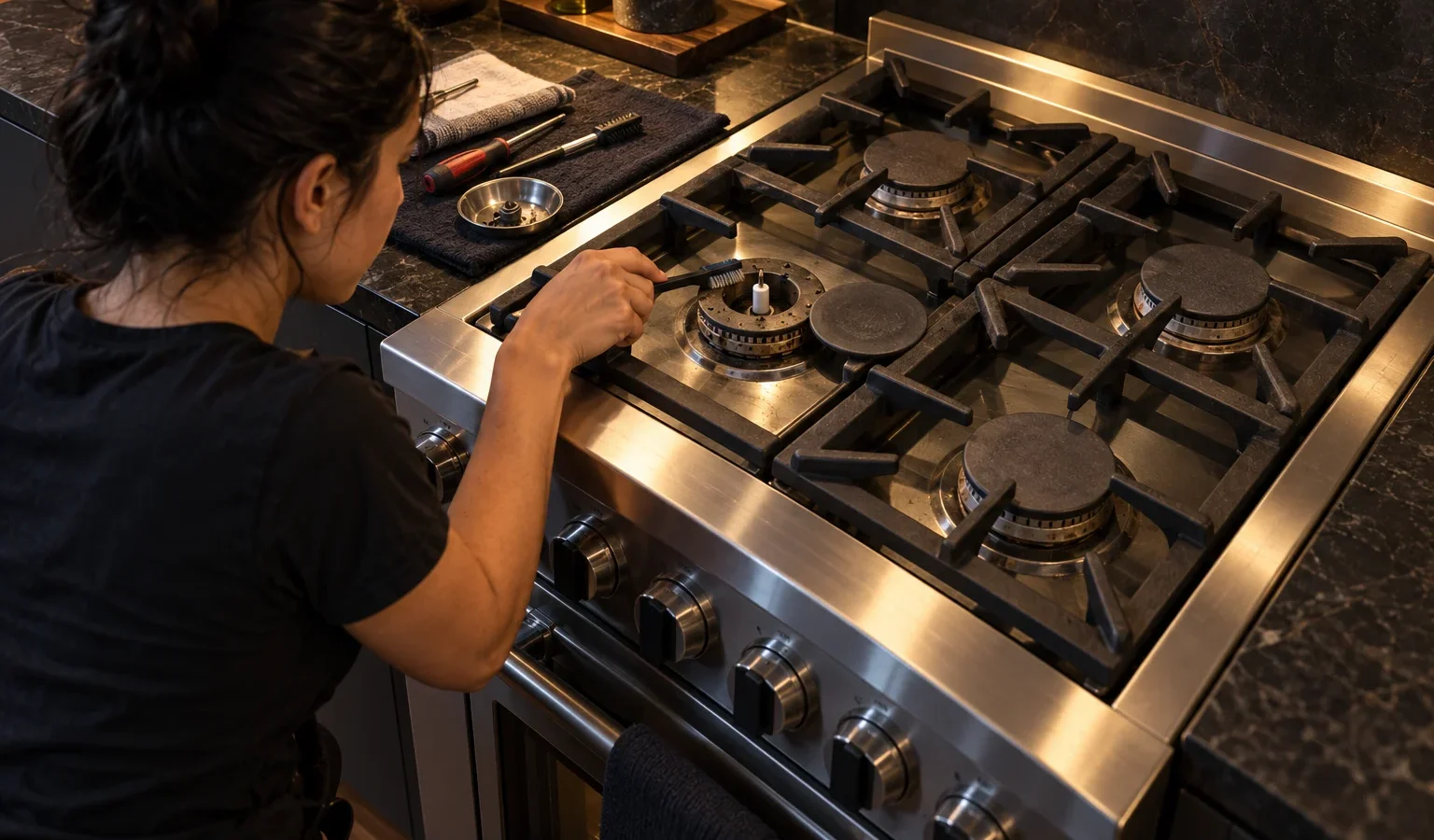
On a gas range, this is usually an igniter, a spark module, a clogged burner port or a gas supply issue. Burners that click but do not light often have wet or dirty caps and ports. On an induction range, the surface may refuse to heat because of the cookware, a control fault or a protection circuit. Our post on a Dacor gas range that keeps clicking goes deeper on the gas side.
The oven has its own sensor, elements or gas igniter and its own relays. A fault there leaves the surface untouched. Our post on a Dacor oven not heating covers that branch in more detail.
Look at power first: the breaker for an electric or dual-fuel range, and the gas valve for gas. If the display is dark as well, the supply is a stronger suspect than any single part. If the display is alive but nothing heats, the control may be locked or may be reporting a fault.
Partial blockages in burner ports, an element that no longer glows evenly, or a sensor reading that makes the oven shut off early can all produce this.
Some Dacor ranges display a fault code. On certain older ranges covered by the Dacor technical manual, a general fault code can be followed by a more specific one. Dacor range F1 is described as a general fault located in the control panel controller board, and Dacor range F30 and Dacor range F31 report a shorted or open temperature sensor. Write down every code you see and the order they appeared, then give the model number with it, because the meaning depends on the control family.
If you smell gas, leave at once, avoid light switches, and call the gas utility or 911 from outside. Do not try to light a burner again and again. If you notice a burning smell or sparks, turn the breaker off. Do not remove the cooktop, touch gas fittings, or open the back panel.
The story around the failure is worth telling. Did the burners stop mid-simmer, or did they never light that morning? Did the oven fail after a self-clean, a power flicker or a kitchen remodel? Did a pot boil over just before? Spills reach igniters and sensors, and a power event can leave a control confused. A short account of the minutes before the problem often points the technician to the right area within moments of arriving.
Dacor makes gas, dual-fuel and induction ranges, and the diagnosis differs a lot between them. The Dacor ER30G repair page covers a gas range, the Dacor ERD30 repair page a dual-fuel one, and the Dacor HIPR30C repair page an induction range. In a San Francisco kitchen, ranges often sit in tight cutouts between cabinets, and a gas connection or a power receptacle may be hard to reach. A professional-style range may have a separate oven and burner supply, which makes it possible for one side to fail while the other carries on.
The model label is usually on the oven frame, inside the door opening, or along the side of the cooking chassis. Give us the full number so we can match it to the right control.
If a half of the range stays cold after the checks, or if a code appears, book a visit. We start with the symptom and any code, test the power and gas supply, then examine the ignition or heating parts on the affected side. A written estimate comes before work, and nothing is repaired without your approval.
Read more on our Dacor range repair page, and see the Dacor ranges guide for the lineup and where the label sits.
The surface and the oven have separate heating parts and controls. A fault in one half rarely affects the other.
We advise against it. A burner that will not light by itself may have a gas or ignition problem, and the safest route is to stop and book a visit.
The display runs on a low-power side. Heating needs its own supply and relays, and a breaker that has partly tripped can leave one without the other.
Yes. Induction needs suitable cookware that sits flat. Try a different pan before assuming the surface has failed.
The model number, whether it is gas, dual-fuel or induction, which part does not heat, any code and what you have tried.
Share a few details and we’ll confirm an appointment. Prefer to talk? Call us and we’ll help right away.