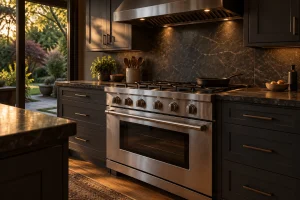
Ranges in San Francisco
Gas, dual-fuel and induction Dacor ranges in San Francisco kitchens. Lineup details, label locations, usual faults and the control codes tied to…

Specialized Dacor Appliance Repair in San Francisco
Mon–Sat: 8:00 AM – 7:00 PM
Burners that click, ovens that stay cold, keypads that stop responding: start with a diagnosis of your Dacor range.
Dacor repairSan Francisco & the Bay Area
A Dacor range is the one appliance in a Bay Area kitchen that is asked to do everything at once: boil, sear, bake and hold a low simmer while the oven runs a long roast. When it starts to misbehave, the symptom usually points to one of a few systems, and sorting out which one is most of the repair. We diagnose and repair Dacor gas, dual-fuel and induction ranges, including professional-style freestanding and slide-in units, at homes across San Francisco and the surrounding Bay Area.
On a gas or dual-fuel range, each sealed burner has a spark igniter beside the burner cap. If a burner keeps clicking after the flame is already burning, the igniter may be wet, dirty or reading a poor ground. If it clicks without lighting, the usual suspects are a clogged burner port, a cap that is seated slightly off, or an igniter that has weakened with age. Our read on the problem is covered in more detail in the article on a Dacor gas range that keeps clicking.
Bake and broil elements, the temperature probe, the relay board that switches power to those elements and the control panel all take part in getting the oven to temperature. A cold oven with a lit display points toward an element or relay. An oven that drifts hot or cold points toward the sensor or its wiring. The checks that separate these are laid out in the guide to a Dacor range that is not heating.
Keys that do nothing, keys that act as if they are being held down, or a display that goes blank are common on older electronic panels. A stuck membrane key, a loose data cable between the panel and the relay board, or a failing board behind the panel can all look alike from the front.
A range that will not unlock after a clean cycle, or that shows a lock fault, has a latch assembly with a motor, cables and switches. Any one of those can interrupt the sequence.
Many Dacor ranges with an electronic oven control report faults as an F code on the display. Write the code down exactly as shown before anything is reset. The meanings below come from the Dacor technical documentation for the ER-style ranges:
Other codes in the same family, such as F10, F11, F13, F14, F15 and F95, each have their own page. A code tells us which area to inspect first; it does not replace the inspection.
A range sits in a tight space, and the space matters. Freestanding units in older flats and row houses often slide into a gap cut for a much simpler appliance, with a gas stub and an outlet hidden behind the back panel. Slide-in and professional-style ranges in remodeled kitchens are set flush to stone counters, so there is little room to pull the unit forward without lifting it carefully over flooring.
Fuel type shapes the visit as well. A gas range depends on a steady supply and a clean spark. A dual-fuel range pairs gas burners with an electric oven, so a problem might sit in either system, and the question of which one failed is the first thing to settle. An induction range has no flame at all; its cooktop works only with compatible magnetic cookware, and faults often show up as pan-detection problems or fan and sensor codes rather than ignition trouble.
If a gas smell is present, leave the home, do not touch any switch, and call the gas utility or 911 from outside. If there is a burning smell, smoke or sparks, turn the range off at the breaker and leave it off.
Stop if a burner stays lit with no flame control, if the oven door will not close, if an element glows unevenly with smoke, or if a lock fault leaves the door stuck during a cycle. Cooking on a range that is already reporting a heat or latch fault turns a small repair into a larger one.
Dacor has made many range generations, from older Distinctive and Epicure units to Discovery and Heritage ranges. Igniters, relay boards, panels and latch parts differ between them, so we ask for the model label before ordering anything. It is usually on the oven frame, inside the door opening, or on a plate behind the storage drawer. Our guide to finding your Dacor model number shows where to look.
You tell us the symptom, the model and any code you saw. At the home, we inspect the range, find the cause, and give you a written estimate. Nothing is repaired until you approve it. The diagnosis comes before the repair, and the estimate comes before the work.
Our Dacor range guide lists the lineup. Models that come up often include the DYRP36DS dual fuel range, the DR30D, the ER30G gas range and the HIPR30C induction range. The ERD30 dual fuel range is another regular. For a range that clicks, start with the article on the clicking burner.
Each burner has its own igniter and its own port. A single clicking burner usually has a dirty port, a cap that is not seated, or a weak igniter, rather than a fault in the whole range.
It depends on the code. Heat, sensor and latch faults are reasons to stop. Write the code down, turn the oven off and let us look before you use it again.
Yes. The burners run on gas and the oven runs on electricity, so one side can fail alone. That split is a helpful clue during diagnosis.
Not necessarily. Induction needs magnetic cookware that sits flat and covers the cooking zone. If a pan that worked before is ignored, a technician should check the zone and its sensors.
It helps us plan, but a visit can be requested without it.
Gas, dual-fuel and induction Dacor ranges in San Francisco kitchens. Lineup details, label locations, usual faults and the control codes tied to…
Repair for Dacor gas, electric and induction cooktops and rangetops across San Francisco and the Bay Area, with diagnosis first and your…
Dacor dishwasher repair in San Francisco and the Bay Area for leaks, standing water, fill problems, heater faults and display codes in…
Repair for Dacor column freezers in San Francisco and the Bay Area: thawing food, heavy frost, drain ice and constant running, diagnosed…
Dacor ice maker repair in San Francisco and the Bay Area, covering empty bins, fused cubes, slow harvests and leaks from the…
Share a few details and we’ll confirm an appointment. Prefer to talk? Call us and we’ll help right away.